


When Anyone Can Be Anyone: AI and the Identity Crisis in Finance


Generative AI is quietly dismantling the verification systems that financial institutions have long relied on. From lifelike deepfakes to entire synthetic ecosystems, the threat is no longer theoretical – and the response must be equally sophisticated.
AI has given criminals an extraordinary new capability: the ability to convincingly be someone else. And in a sector built almost entirely on the premise of knowing who you are dealing with, the consequences are profound.
The ACAMS Global AFC Threats Report 2026 ranks AI-powered identity fraud as the second most significant threat facing anti-financial crime professionals globally, trailing only AI-driven scams in the overall threat rankings. That distinction matters less than the convergence: the two threats are deeply intertwined, and together they represent a fundamental challenge to how trust is established in the financial system.
75% Rate malicious generative AI use as high or very high risk | 56% Of institutions now piloting or actively using AI in compliance | 19% Cite identity theft & synthetic fraud as hardest typology to detect |
Documentary identification is becoming "essentially useless"
That stark phrase came from an anti-financial crime leader participating in ACAMS roundtable discussions — and it captures the scale of the problem with unsettling clarity. Advanced AI tools can now replicate the physical security features embedded in identity documents: holograms, microprinting, ultraviolet imagery, and scannable barcodes. More alarmingly, they can generate convincing facial photographs capable of defeating biometric verification checks.
This is not a marginal improvement on existing forgery techniques. It represents a step-change in what is possible. Where physical document forgery once required specialist materials and skills, AI-assisted identity fraud can be conducted by actors with modest technical capability, using off-the-shelf tools and guidance that circulates freely on dark-web forums.
"Documentary identification is becoming essentially useless." — AFC leader, ACAMS Executive Roundtable, 2025 |
The vulnerability extends well beyond documents themselves. Voice cloning technology can replicate an individual's speech patterns from just a few seconds of recorded audio. Video deepfakes have reached a level of realism that challenges even trained human reviewers. Image recognition systems — used in liveness detection and selfie-based identity verification — are increasingly defeated by sophisticated spoofing techniques.
The rise of synthetic ecosystems
What makes this threat particularly difficult to counter is the sophistication of what fraudsters are building behind the scenes. This is no longer just about a fake passport or a borrowed credential. Fraudsters are now constructing entire synthetic ecosystems: complete fictional identities supported by fabricated businesses, websites, customer reviews, and social media profiles — all maintained by autonomous AI agents operating with minimal human oversight.
These synthetic entities can pass initial due diligence checks, build a plausible transaction history, and then be activated for fraud at scale. The lag between creation and exploitation can span months, making detection by retrospective analysis increasingly difficult. By the time anomalies surface, the damage is often already done.
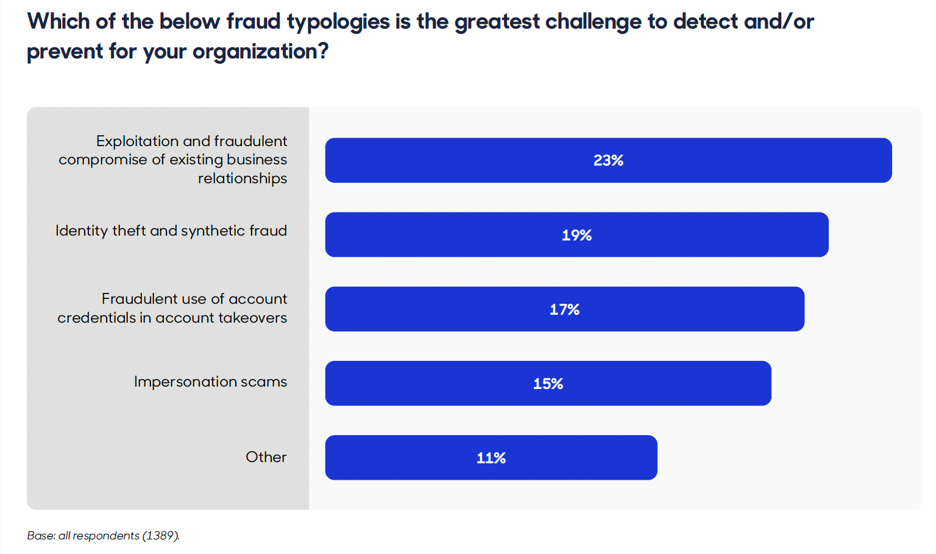
The data reflects just how hard these typologies are to catch. Identity theft and synthetic fraud ranks as the second hardest fraud typology to detect or prevent, according to our members.
The volume problem: fraud attempts now outpace defences
Traditional identity verification systems were designed for a different threat environment. They assumed that fraudsters were constrained by time and resources — that assembling a convincing false identity, targeting the right institution, and executing a fraud attempt was inherently labour-intensive. AI removes those constraints almost entirely.
The volume and velocity of identity fraud attempts now routinely outpace existing defences. A single automated campaign can submit thousands of synthetic applications across multiple institutions simultaneously. Compliance teams, already stretched by alert volumes and skills shortages, cannot manually review each case. Rule-based systems generate false positives at scale, eroding confidence in the alerts they do surface.
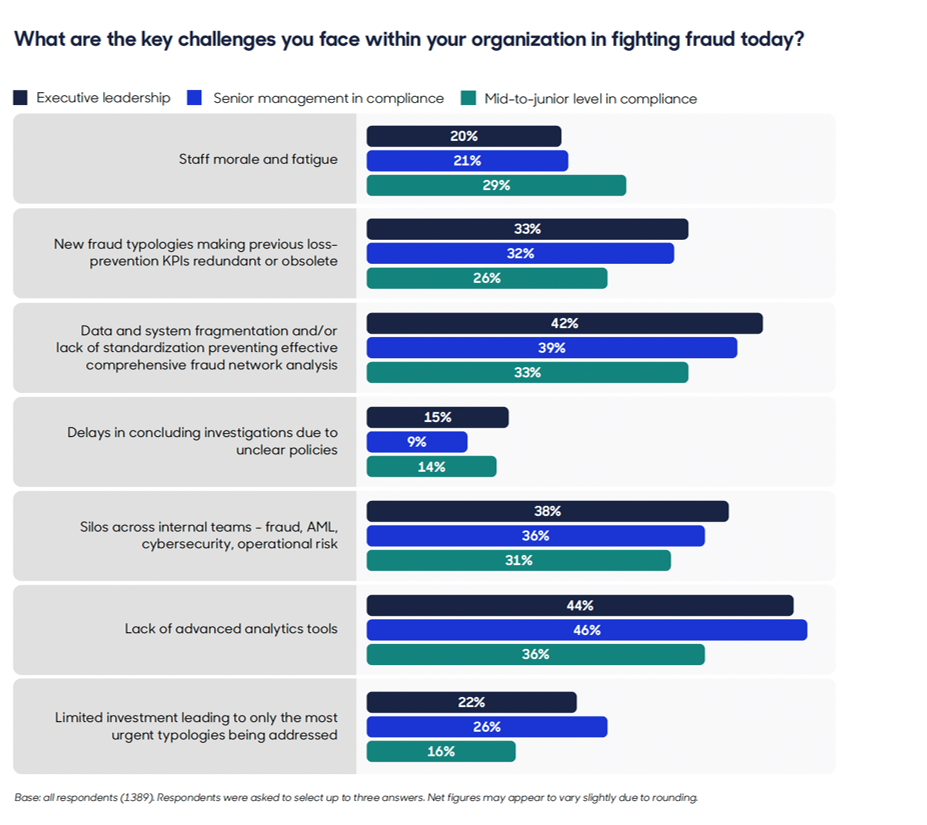
The ACAMS survey data reflects this operational pressure sharply. Outdated legacy IT and fragmented data architectures are consistently cited as the top internal risk to effective financial crime functions — identified as high or very high risk by 52% of respondents. These are not abstract concerns: they directly limit an institution's ability to deploy the AI-based detection systems needed to respond to AI-powered attacks.
A paradigm shift in how institutions respond
The path forward is not simply adding more verification steps to existing processes. That approach merely inconveniences legitimate customers while sophisticated attackers route around the friction. What is needed is a fundamental reconsideration of how identity is established and continuously validated.
Moving beyond static verification
Institutions should be investing in multilayered, dynamic verification architectures that combine advanced biometrics with device fingerprinting, geolocation analytics, and behavioural pattern recognition. These signals, taken together, create a composite picture of an interaction that is substantially harder to fake than any single document or selfie. The goal is not to find a single definitive proof of identity, but to accumulate sufficient corroborating evidence across multiple independent channels.
Authoritative data cross-referencing
Where regulatory frameworks permit, institutions should be leveraging authoritative data sources — government identity registers, credit bureau data, telco records — to cross-reference claimed identities in real time. This does not eliminate the problem, but it significantly raises the cost and complexity of building convincing synthetic personas. Fraudsters who must fabricate consistent records across multiple independently-verifiable databases face a much harder task than those targeting institutions relying solely on document checks.
Intelligence sharing as infrastructure
No individual institution will solve this problem alone. The fraud typologies enabled by AI are evolving rapidly, and the intelligence needed to counter them — new deepfake signatures, emerging synthetic identity patterns, dark web toolkits — is distributed across the entire sector. Industrywide intelligence sharing mechanisms, where institutions can share sanitised indicators of compromise without breaching data protection obligations, are increasingly essential.
The human dimension: skills, trust, and institutional culture
Technological responses alone will not be sufficient. The ACAMS report is clear that talent retention and skills gaps remain critical internal vulnerabilities — cited as a high or very high risk by 47% of respondents. Detecting AI-powered identity fraud requires analysts who understand both the technical dimensions of the attacks and the human behavioural signals that machine systems can miss.
There is also a cultural challenge. Building institutions where staff feel empowered to escalate unusual verification requests, where second-channel confirmation is normalised rather than viewed as customer friction, and where vigilance is embedded in operational practice rather than treated as an exception — this is slow, difficult work that does not yield to technology solutions alone.
"In this new era, resilience is not optional — it is the cornerstone of trust and security." — ACAMS Global AFC Threats Report 2026 |
The irony of the current moment is that the same AI capabilities that are empowering fraudsters are also available to defenders. Machine learning models trained on patterns of synthetic identity construction, behavioural analytics platforms that can identify the subtle inconsistencies that betray autonomous agents, and AI-assisted investigation tools that can surface connections across fragmented datasets — these are all now accessible to financial institutions willing to invest in them.
The gap between attackers and defenders remains significant. But it is not unbridgeable. The institutions that will navigate this most successfully are those that treat identity verification not as a one-time onboarding check, but as a continuous, evolving process — and that build the data infrastructure, human capability, and collaborative relationships needed to sustain it in an environment where the threat is never static.
Trust, in the end, is what the entire financial system runs on. AI-powered identity fraud is an attack on that trust at its most fundamental level. The response must be proportionate to the threat.
How ACAMS can help you stay ahead of fraud in 2026
- Read the latest report for deeper insights and industry data on fraud and emerging financial crime threats.
- Strengthen your fraud defenses with the CAFS certification.
- Explore the monthly Fraud Watch series for trends, themes, and practical steps to combat scams.
- Browse our fraud resource library for guidance on insider threats, cyber-enabled fraud, and our briefing on how fraud risks are expected to evolve.
Source: ACAMS Global AFC Threats Report 2026. Based on 1,389 unique survey responses collected September–October 2025 across 200+ jurisdictions. Survey conducted in partnership with YouGov.
Key Lines of Defense Against Synthetic Identity Fraud, Identity Theft and Account Takeover
Collective Intelligence: Moving Beyond Data Silos
Charitable and volunteer organizations in the U.K. and Ukraine
Masterclass: Dark Fleet Decoded — Maritime Intelligence for Investigators
Navigating the human perimeter in regulatory cyber resilience
Key Lines of Defense Against Synthetic Identity Fraud, Identity Theft and Account Takeover
Collective Intelligence: Moving Beyond Data Silos
Address poisoning attacks: Exploiting blockchain and cognitive vulnerabilities
Dismantling the financial networks behind human trafficking-enabled scams
Collective Intelligence: Moving Beyond Data Silos
Address poisoning attacks: Exploiting blockchain and cognitive vulnerabilities
Troy La Huis: From cost center to trust center in financial crime compliance
Collective Intelligence: Moving Beyond Data Silos
Human trafficking: The dangers of sports events