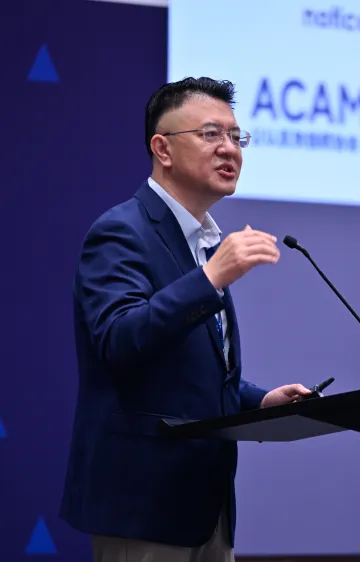


Jason Blazakis: Fostering the fight against terrorism

ACAMS Today sat down for an interview with Jason Blazakis following his book signing at the Assembly Hollywood. Blazakis’ recently published book is titled: “Terror Disrupted: Countering the Financing of Terrorism,” an insider’s account of how national security services track terrorist financing and what works to disrupt it. The analysis in the book goes beyond banks to examine the role of the private sector and cryptocurrency forensic firms on the front lines of preventing terrorist access to emerging forms of value, including digital assets. His book is available for purchase on Amazon.
Blazakis specializes in terrorist financing, sanctions, violent extremism and special operations research. From 2008 to 2018, he was the director of the Office of Counterterrorism Financing and Designations at the U.S. Department of State’s Bureau of Counterterrorism. Prior to that, Blazakis held positions in the State Department’s Bureau of Political-Military Affairs, Bureau of International Narcotics and Law Enforcement Affairs, Intelligence and Research, and at the U.S. Embassy in Kabul. Currently, he is a professor of Global Studies at the Middlebury Institute of International Studies (MIIS). Blazakis is also the executive director of MIIS’ Center on Terrorism, Extremism and Counterterrorism.
Before joining the State Department, Blazakis was a national intelligence analyst at the Congressional Research Service. He also served as a national security advisor to a member of the U.S. Congress. In addition, he worked in the Technology Administration at the U.S. Department of Commerce.
The interview below is an edited excerpt of the conversation between Blazakis and ACAMS Today’s Editor-in-Chief Karla Monterrosa-Yancey.
ACAMS Today (AT): During your session at the ACAMS Assembly in Hollywood, you mentioned the consequences or problems arising from people worshiping artificial intelligence (AI) as deities, can you please expand on this issue?
Jason Blazakis (JB): The potential consequence is when individuals who become part of a cult see their world threatened by an outside entity. Their world becomes extremely different, and they become quite threatened.
As a consequence, they might be willing to lash out and carry out acts of violence because the large language model (LLM) they worshipped has been taken away from them.
I see this same kind of world potentially developing in this AI space because there are groups—multiple now—that have unfortunately come to a point where they either worship AI in LLMs or those on the other side of the ledger (but also equally dangerous) who see AI as God-like and as an existential threat.
I mentioned this one group called the Zizians. They see AI as being a superbeing, but as an existential threat and because of this worldview, they’ve carried out several attacks throughout the country.
[Regarding] this idea of developing rituals to worship an LLM, treating it as a deity or as a god: When people become religiously motivated, we’ve seen some horrible examples of terrorism when religion becomes extreme.
In the world of terrorism, you can point to groups like the so-called Islamic State group (IS), who have a very perverted worldview of what Islam means. The same can hold true for any kind of extremist group that carries out violence in the name of religion.
AT: Regarding your recently published book: “Terror Disrupted: Countering the Financing of Terrorism,” how are governments determining who to designate as a terrorist?
JB: One of the big things I was trying to demystify in the book is that the State Department plays a significant role as it relates to the terrorism designation under Executive Order 13224, which is a shared legal authority that the State Department has with the Treasury Department.
My old job at the State Department was to lead an office that would send recommendations to the Secretary of State about who should be labeled a foreign terrorist organization or who should be labeled a terrorist.
When I was the head of the office, I would have analysts who were going through what we call all source information, classified information, highly classified information, plus unclassified information, to tell a story to the Secretary of State about who should be labeled as a terrorist and how they meet the legal criteria for the designation.
Receiving such a designation would have an outcome for an individual or a group to have their assets frozen pursuant to U.S. law. If somebody tries to provide support to a designated actor, they can be prosecuted under U.S. law and if somebody is part of a designated foreign terrorist organization, they are deemed inadmissible into the U.S.
AT: Do you extend the designation of terrorist to family members?
JB: They wouldn’t be necessarily the target of what we call the primary listing. The primary listing is the listing of the terrorists. For example, Abu Bakr al-Baghdadi was the head of IS. We didn’t list Abu Bakr al-Baghdadi’s wives.
Let’s pretend Abu Bakr al-Baghdadi has an account, which is very unlikely, but let’s say he has an account at a Turkish bank. That bank, especially if it has a correspondent banking relationship, is probably not going to bank Abu Bakr al-Baghdadi’s family.
The primary listing has a secondary effect, and that’s why a lot of terminology goes around this secondary effect. You don’t have to list everybody to have that secondary impact. What a bank is going to conduct is due diligence and say, well, “Abu Bakr al-Baghdadi is on the SDM list. This would introduce significant risk for us and we’re not going to open that account on their behalf.” There’s also a lot of discussion historically between the U.S. and Europeans. This has had an extraterritorial effect. The effect of U.S. designations going beyond the contours of the U.S. and other governments is because of the power of the U.S. dollar. As a result, other governments are going to respect a U.S. listing and it’s ultimately going to have this secondary effect on family members of a terrorist. Governments can make sure in situations like this that family members are able to receive basic human rights, such as food and clothing.
AT: In your opinion, why is the involvement of the private sector of critical importance in the fight against terrorism?
JB: The private sector is on the front lines when it comes to illicit financial activity. It’s not the government that’s deciding to put a hold on an account or stop a transaction from moving forward, it’s the financial institution (FI), the bank and the credit union that’s doing that work and it’s the virtual asset service provider that's doing it if we’re talking about virtual assets. Sometimes the public doesn’t understand how important the role of the private sector is in this economic battle space.
Second, because the private sector is so vitally important, it’s incumbent that the government treats the private sector as a co-equal partner and I don’t think the government does that all the time. To be successful there needs to be true partnerships.
AT: Regarding partnerships, the experiences we see mostly in ACAMS Today are from the U.S., would you say that creating successful partnership is a global challenge?
JB: The U.K. has done this for an extended period, relative to other governments, and their model has been adopted by other governments: Australia, Singapore and others. It seems other governments are doing better than the U.S. in this space on public-private partnerships and financial information-sharing relationships.
I say this because when it comes to how the U.S. thinks about intelligence and sharing information, the U.S. historically is quite hesitant in sharing information.
In the early days prior to 9/11, even with each other as government agencies, we famously know the FBI and the CIA were not sharing information with one another because they didn’t trust each other.
When you think about this—and we're only 20 years past 9/11—essentially, the idea of sharing sensitive information with the private sector is still something that is mind-boggling to people in government, even though I think that it’s vitally important.
The government is hesitant to reveal any of the sources and methods used to acquire the intelligence to protect the people who provide the U.S. government such critically essential information. But if we're going to operationalize that information, the private sector needs to be part of that conversation.
AT: You also mentioned that people who created these AI models need to be part of these partnerships. So, what is your recommendation to a traditional financial institution? How do you bring these partnerships together?
JB: I would love to see a troika: private, private with government. I would like to see the government in the room with compliance professionals and financial institutions (FIs) with trust and safety and financial experts who might be connected to LLM companies, whether it's Anthropic, OpenAI, Google Gemini—whatever the case may be.
These companies have people who are experts on trust and safety issues about how bad actors might try to use their models in nefarious ways, but they’re very small relative to, say, broader social media companies that have been battling in this space for 15, 20 years now.
I would love to see that kind of troika partnership manifest because it would be a win-win-win, especially as these LLMs become much more sophisticated.
These partnerships are only going to grow and be able to do the work of individuals who might be in this illicit space at a much faster speed than ever before. For this reason, it’s important that we try to have these partnerships manifest as quickly as possible.
AT: Can you tell us more about the radicalization of children?
JB: Yes, I can’t be too specific, but there's a case in the Eastern District of New York that I’ve been working on as this individual gets closer to being sentenced for the plot he had planned in the state of New York that thankfully was thwarted because of LE.
I carried out an interview with him as part of his defense counsel’s request to probe what was his genesis as an individual—from the early days of his exposure to toxic online content to the plotting of the attack. It was clear to me that at a very young age he was exposed to toxic material, but also to individuals who manipulated him as well in these online spaces, specifically in places like Telegram. But ultimately, that furthered his radicalization to a point where in his early 20s, he carried out this plot. He was shaped in my mind, by the algorithm.
Recently, there are some court cases, civil suits in California that have been decided in favor of victims who, either because of addiction or things that are unrelated to violence—their family members said our kids are just ruined because of the content that is being recommended to them by the algorithm that is associated with YouTube or X. It creates angry people. How do we get kids away from this dangerous content?
Well, it is going to be incumbent on parents and schools to really try to help young people better understand their digital identity and how bad actors might try to manipulate them. There is no financial solution to this. Really the solution is in education and mental health. However, it's important for financial professionals to understand that this world exists.
AT: Currently, what is the biggest terrorist threat and how can AFC professionals see the red flags in terrorist financing?
JB: From a U.S. perspective, I think that the most dangerous threat—because conventional tools can’t be used to go after these types of challenges—are inherently domestic threats. Whether from so-called far-right white supremacist individuals or the so-called far-left, there aren’t designations that could be put in place to sanction these individuals. They can’t be named, and you can’t check an SDN list for them. So how do you handle a problem like that? It is not simply by looking at the finances, it's about using open-source investigations, to understand the totality of an individual who might be walking down this dangerous pathway.
There might be some small financial marker, for instance, that can be indicative of something problematic. But do you have other people on the team who could do an open-source investigation looking at social-media-related kinds of analysis to stitch this together? That might present some challenges internally with an institution as a matter of investigation and law that must be carefully reviewed by lawyers in-house.
Ultimately, it is about stitching together the whole picture of the terrorist, not just focusing on the financial portion.
AT: For AFC professionals who want to work in the intersection of counterterrorism, sanctions and financial intelligence, what skills or experiences matter most now compared to 20 years ago?
JB: When I was breaking into government, a little bit more than 20 years ago, the most important skill was the ability to communicate. This is still very important and not just relying on LLMs to do all the communication for you.
Communication is something that’s timeless: written communication and being able to brief and talk to people in persuasive ways. That is the number one skill.
The second skill is having fluency on artificial intelligence (AI). As much as I've been critical of AI, it’s not going away, and we need to understand how LLMs function and how they can be potentially manipulated by bad actors. That might require some inquisitiveness, some creativity, some red teaming within banks to understand how these tools can potentially be leveraged for illicit financial purposes. Becoming increasingly familiar with the world of LLM, AI-adjacent and AI-related technologies operating in the AFC space is especially important.
AT: What is next in the horizon for terrorist financing? What should we be looking for or what should we be preparing for?
JB: Anthropic has created this new LM called Mythos that can also decrypt highly sophisticated encryption. What does that mean for FIs if Mythos, for instance, was leaked to the public?
Right now, Anthropic is talking about just making sure the government can test it and access it. But if I were these LLMs, in this case Anthropic, I’d be sharing with large banks also so banks can prepare for the day that Mythos is leaked or stolen from Anthropic and is used by a bad actor to break decryption at a bank to steal funds in illicit ways. That countries like North Korea would take advantage of. Because this could be a new way in which North Korea could fund their weapons of mass destruction program. North Korea is well known for having sophisticated cyber theft skills and they have stolen billions of dollars of crypto over the last several years.
AT: With the upcoming World Cup, do you have any advice for FIs?
JB: Yes. I did an interview at the beginning of the Iranian conflict with a sports publication about this issue. I do have deep concerns, especially about Iranian responses and Iranian proxy group responses around the World Cup.
Just as we saw in 9/11, al-Qaida hijackers used the formal financial system while they were in the U.S. to do flight training, I can see the same thing happening with a disenchanted proxy group associate of Iran using the formal financial system to plot an attack at a major sporting event.
The World Cup is a major sporting event, but also an event that is happening with the backdrop of the conflict between U.S. and Iran. It is going to be incumbent on financial investigators to be thinking about those unique diaspora-related characteristics that could be linked to Iranian actors.
Due diligence, to make sure that these individuals aren’t politically exposed to Iran, is going to be important. At the same time, not all that burden should fall on the private sector. The government should also provide granular information to the private sector about what they’re observing in terms of intelligence. They don’t have to jeopardize their sources and methods to see that there might be a new typology happening that can connect to the World Cup, where FIs should be involved. It gets back to our public-private partnership discussion. That's going to be critically important.
Interviewed by: Karla Monterrosa-Yancey, CAMS, editor-in-chief, ACAMS, editor@acams.org
Global Roundtable: Geopolitical State of Play – Iran, Cuba, and Venezuela
Human trafficking: The dangers of sports events
Collective Intelligence: Moving Beyond Data Silos
Agentic AI: Game changer for FCRM autonomy or fool’s gold?
Collective Intelligence: Moving Beyond Data Silos
Charitable and volunteer organizations in the U.K. and Ukraine
Collective Intelligence: Moving Beyond Data Silos
How comprehensive blockchain innovation improves economies
Charitable and volunteer organizations in the U.K. and Ukraine
In Focus: AFC Regulatory Watch - April 2026
Human trafficking: The dangers of sports events
AFC Trends & Typologies: Examining the U.S. Administration’s Priorities
Human trafficking: The dangers of sports events
Collective Intelligence: Moving Beyond Data Silos
When Anyone Can Be Anyone: AI and the Identity Crisis in Finance
Collective Intelligence: Moving Beyond Data Silos
Human trafficking: The dangers of sports events