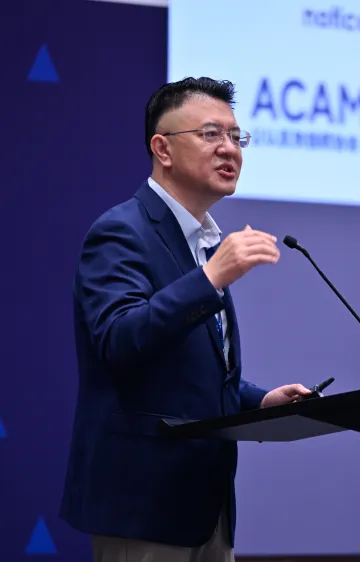


AFC leaders share their experience and advice as ACAMS Scholarship judges


ACAMS Today spoke with a few of the judges for the new ACAMS Scholarship program to gather some real-world insight behind the revamped ACAMS Scholarship. The following is a Q&A with a few of the esteemed judges—industry leaders who bring a deep experience in financial crime prevention and compliance. They offer a unique perspective on what excellence looks like in the next generation of anti-financial crime (AFC) professionals. Through candid conversations, readers can gain valuable career advice, learn what a winning application looks like, and gain a better understanding of the skills and values shaping the industry.
Introduction of judges

Let us meet the judges. The first judge, Simon Lee, is a deputy general manager of personal banking at the Bank of China (Macau). His career in anti-money laundering/counter-terrorist financing (AML/CTF) and sanctions compliance began in 2016, when he obtained the ACAMS Certified Anti-Money Laundering Specialist (CAMS) certification. By early 2020, he was selected as part of the first group of CAMS instructors in Macau who were tasked with training AML professionals in the Asia Pacific region. In early 2023, he earned the Certified Global Sanctions Specialist (CGSS) certification.

The second judge, Tara Griffith is a financial services professional with extensive experience in payments operations and regulatory compliance. In her current role as assistant vice president of operations and Office of Foreign Assets Control (OFAC) officer at Corporate One, she oversees complex payment environments while ensuring compliance with AML/Bank Secrecy Act, OFAC and sanctions requirements. She holds several professional credentials, including the FedNow certification and the CAMS designation. Griffith likes to stay current with regulatory change and emerging risk.

The third judge we spoke with, Jose Cerdeira, is an accomplished senior financial crime expert/money laundering reporting officer with extensive international experience across Fortune 500 institutions, such as Deutsche Bank, Barclays, Western Union, Amazon, American Express and the VW Group. He is known for leading complex, cross-jurisdictional AML compliance programs and has a proven track record in strategic AML/CTF framework development, regulatory change management and stakeholder engagement.
ACAMS Today (AT): What motivated you to volunteer as a judge for the ACAMS Scholarship?
Simon Lee (SL): As an experienced AML specialist, I am eager to see more young talent with the capability and interest to join this industry and not be discouraged due to financial constraints. Although employers at large institutions often provide subsidies or even fully cover the costs of obtaining the CAMS certification, many employees at small- to medium-sized companies do not have access to such financial support for staff education and training, and must pay for course and examination fees out of their own pockets. Financial considerations weigh even more heavily on young professionals who are at the early stages of their careers.
When I received the invitation to serve as a judge for the ACAMS Scholarship, my instinct told me that this is a truly meaningful opportunity—because I now have the chance to contribute my experience and knowledge to help ACAMS select the most promising candidates who are passionate about AML and committed to building a career in this field. It is truly an honor to be part of the selection process.
Tara Griffith (TG): I was motivated to volunteer as a judge for the ACAMS Scholarship because I have personally experienced how access to education, mentorship and professional development can change the trajectory of a career. Early in my journey, I benefited from individuals and institutions that invested time and resources in my growth, and this role allows me to pay that forward in a meaningful way. Serving as a judge enables me to help identify emerging talent that may otherwise go unnoticed and to contribute to the long-term strength of the AFC profession.
Jose Cerdeira (JC): It’s my first time as a judge for the ACAMS Scholarship initiative, and I see it as a great opportunity to support the next generation of AFC leaders. What really motivates me is thinking that in 5–10 years, some of these candidates could be leading AFC teams, making key decisions and shaping the future of our industry. If I can play even a small role in that journey, it’s worth it.
AT: Why do scholarship programs like this matter to the AFC community? What does giving back through this role mean to you personally?
SL: The ACAMS Scholarship is the first of its kind in the AML and AFC sector. I remember when I first obtained the CAMS certification about 10 years ago, scams were not a hot topic in the AFC community. Nowadays, scams have become one of the most frequent problems and threats affecting all walks of life in society.
Part of my current role is to combat financial crime at a bank. I have seen many victims lose their entire life savings simply by answering a single phone call from scammers. This is a life-changing moment for ordinary people. The side effects on self-confidence and trust in others can sometimes have a greater impact than the financial loss itself.
Although we now have advanced technical tools to assist us in AFC efforts, human intervention remains crucial in handling suspicious transactions, conducting investigations and making recommendations on control measures. In this sense, sufficient training for young AFC professionals is vital for the sustainable development of the AFC sector.
Serving as a judge for the ACAMS Scholarship means that I have one of the best opportunities to pass my AFC knowledge to the next generation through the assessment of candidates in the ACAMS Scholarship program.
TG: Scholarship programs like this one are essential to the AFC community because they help ensure the profession remains accessible, forward-looking and representative of the global environments we serve. Financial crime is constantly evolving, and our ability to respond effectively depends on cultivating talent with diverse perspectives and skills. Scholarships help remove barriers that might otherwise prevent capable individuals from entering or advancing within the field.
From a community standpoint, these programs strengthen the talent pipeline and reinforce a shared commitment to ethical leadership and lifelong learning. They also send a clear message that the AFC profession values inclusion, mentorship and social impact, alongside technical expertise.
On a personal level, giving back, through this role, is deeply meaningful. It allows me to support motivated and purpose-driven individuals in our line of work.
JC: Today, training is critical. The challenges we face in AFC are becoming more complex and global. Programs like this help develop talent across different jurisdictions and backgrounds. For me, it’s also personal. I’ve been lucky to learn from great leaders over the last 25 years. This is my way of giving back—supporting others with the same opportunities I had.
AT: Are there any specific qualities you will be looking for in candidates when going through the selection process?
SL: When I lead my team at work, I emphasize that the rule of thumb for becoming a successful AFC professional is to have a solid understanding of the principles of financial crime typologies—and then apply those principles to solve real-world problems. There are colleagues who try to memorize all the red flags listed in AFC rulebooks and jump to conclusions after ticking every box on a checklist, without considering new trends or emerging typologies.
In the selection process, candidates with a logical-thinking mindset are preferable to those with merely an administrative approach. If we only stick to what we know, it is clearly not enough to stay ahead of them.
Another key quality in candidates is a naturally suspicious mindset. Criminals often deceive us by presenting a “too good to be true” personal profile or business narrative when they approach the bank to open an account. If bank staff lack a suspicious mindset, they may easily accept such cases at face value and wrongly classify high-risk individuals as low-risk customers.
TG: When reviewing applications, I look for a combination of purpose, potential and integrity. Strong candidates clearly articulate why they are drawn to AFC work and how their values align with the mission of protecting financial systems and society at large.
JC: Passion, curiosity and integrity. If you truly enjoy AFC, it stops feeling like a job. That mindset makes a big difference.
I also look for curiosity. The best professionals are the ones who ask questions, who want to understand the “why” behind the things and not just follow processes.
Finally, integrity is important. At the end of the day, our careers become roles of trust with our colleagues, board members, customers and regulators.
AT: What would make an application feel more authentic or memorable?
SL: We are in a protracted battle against criminals who constantly seek to outsmart us. I would like to see an application that presents a realistic background story based on an actual or plausible case and demonstrates the techniques of fact-finding through investigation—and even interrogation of suspects—followed by the implementation of effective new control measures. Such a narrative that makes the materials feel authentic, which is far more compelling than reading a textbook, for example. It is a valuable opportunity for candidates to show the judges that they possess solid knowledge and practical skills to address real-world cases.
TG: Authenticity comes through when a candidate tells their story with intention rather than trying to fit a perceived ideal profile. Applications are most memorable when they clearly explain the “why”—why this field, why now and why ACAMS.
I also find applications more compelling when candidates are specific. Rather than broad statements about wanting to “fight financial crime,” strong applicants describe the areas that interest them, the skills they hope to develop and the impact they want to make. This level of detail signals genuine engagement and self-awareness.
Honest acknowledgment of challenges, gaps in experience or ongoing growth areas often resonate more than overly polished responses. I don’t look for perfection; I look for commitment, potential and alignment with ACAMS’ mission.
In addition, the discovery of a new typology would make an application stand out and leave a lasting impression on me. I understand this is not easy, as the cases presented by candidates are ultimately fictional. However, identifying a novel typology requires candidates to draw on practical experience in handling financial crime cases in their professional roles; therefore, I would be genuinely impressed if I were to see such insight in an application.
JC: Be yourself. No need for perfect answers—just be real. I also value real examples: nothing big, just a project, challenge or situation where they had to make a decision.
AT: How important is the candidate’s ability to demonstrate a long-term commitment to AFC work in the selection process?
SL: AFC work requires the accumulation of experience, which comes from practical exposure to handling financial crime cases daily. Therefore, long-term commitment is the foundation for becoming a true and successful AFC professional. Besides, AFC work can sometimes be somewhat tedious. If a candidate does not have passion and long-term commitment to this field, it may not be conducive to their career development in the long run.
TG: Demonstrating a long-term commitment to AFC work is very important in the selection process, as the scholarship is intended to support individuals who see this field as a meaningful and sustained career path.
That commitment does not need to be expressed through decades of experience. It can be shown through consistent educational choices, volunteer work, relevant certifications or thoughtful career planning. Ultimately, the goal is to invest in individuals who will remain engaged, adaptable and ethically grounded as the AFC landscape evolves. A clear sense of purpose and long-term motivation helps demonstrate that the scholarship will have a lasting impact not only on the recipient but on the broader AFC community.
JC: It’s like preparing for a marathon. You need consistency, discipline—and don’t forget to enjoy the journey! If you are curious, engaged and motivated, the effort becomes more sustainable.
AT: How can a candidate’s background show commitment to one of ACAMS’ social impact pillars?
TG: A candidate’s background can reflect commitment to ACAMS’ social impact pillars through professional experience or personal initiatives, such as work in financial inclusion, consumer protection, corruption prevention or promoting fairness within financial systems. Community involvement, mentoring or advocacy efforts can further demonstrate this alignment. A linear career path is not required; what matters most is the candidate’s ability to thoughtfully connect their experiences, values and future goals to ACAMS’ mission and to show awareness of the broader societal impact of financial crime and their role in addressing it.
JC: It doesn’t need to be something big or formal. Small actions matter. Volunteering, mentoring others, supporting financial inclusion or even raising awareness about financial crime risks in your community—these are all strong signals. What I look for is intention. If someone has taken steps, even small ones, to make a positive impact, it shows they understand that AFC is not just about regulation—it’s about protecting society.
Interviewed by: Karla Monterrosa-Yancey, CAMS, editor-in-chief, ACAMS, editor@acams.org
AFC Trends & Typologies: Examining the U.S. Administration’s Priorities
Human trafficking: The dangers of sports events
Collective Intelligence: Moving Beyond Data Silos
How comprehensive blockchain innovation improves economies
Charitable and volunteer organizations in the U.K. and Ukraine
Collective Intelligence: Moving Beyond Data Silos
Address poisoning attacks: Exploiting blockchain and cognitive vulnerabilities
When Anyone Can Be Anyone: AI and the Identity Crisis in Finance